8 min readPublished 12 April 2025
AGM stands for Absorbent Glass Mat, a battery technology that uses fiberglass mats to hold electrolyte instead of free-flowing liquid. AGM batteries are essential for modern vehicles with Start/Stop systems, regenerative braking, and high electrical loads.
This guide explains what AGM batteries are, how they work, their benefits, and when you need one for your vehicle.
Quick Answer
AGM (Absorbent Glass Mat) batteries use fiberglass mats to hold electrolyte, making them sealed, vibration-resistant, and capable of high performance. They're required for advanced Start/Stop systems and vehicles with regenerative braking.
Common causes
- -Modern vehicles with Start/Stop systems require AGM or EFB batteries
- -Premium vehicles with regenerative braking need AGM technology
- -High electrical load applications require AGM's superior performance
Typical fixes
- -Check your vehicle specification - Start/Stop and premium cars need AGM
- -Replace like-for-like if your car originally had an AGM battery
- -Never downgrade from AGM to standard flooded - it will fail quickly
AGM Battery Overview
Advanced Start/Stop with regenerative braking
Likely cause: Vehicle requires AGM battery
Next step: Install AGM battery and register with BMS
Premium vehicle with high electrical loads
Likely cause: AGM battery recommended or required
Next step: Check vehicle specification and install appropriate AGM
Standard battery failing in Start/Stop car
Likely cause: Wrong battery type - needs AGM or EFB
Next step: Upgrade to AGM for best performance and longevity
What Is an AGM Battery?
AGM (Absorbent Glass Mat) batteries are a type of sealed lead-acid battery where the electrolyte is held in fine fiberglass mats pressed tightly against the plates. This design eliminates free-flowing liquid, making AGM batteries completely sealed and maintenance-free.
The fiberglass mat design provides several advantages: better vibration resistance, higher power density, faster charging, and the ability to handle deep discharge cycles without immediate damage.
- AGM stands for Absorbent Glass Mat
- Electrolyte held in fiberglass mats, not free-flowing liquid
- Completely sealed and maintenance-free
- Superior performance for modern vehicle applications
How AGM Batteries Work
AGM batteries use the same lead-acid chemistry as standard batteries, but the electrolyte is absorbed into fiberglass mats. The mats are compressed tightly against the plates, creating a low-resistance path for current flow while preventing acid stratification.
This construction allows AGM batteries to deliver high current quickly, accept charge rapidly from smart alternators, and withstand thousands of deep discharge cycles that would destroy standard batteries.
- Fiberglass mats absorb and hold electrolyte
- Mats compressed against plates for low internal resistance
- Sealed design prevents acid leakage and maintenance
- Can be mounted in various orientations (except inverted)
AGM Battery Benefits
AGM batteries offer numerous advantages that make them essential for modern vehicles and superior to standard flooded batteries.
- Up to 3x the cycle life of standard flooded batteries
- Excellent vibration resistance for commercial vehicles
- Fast charge acceptance from smart alternators
- Deep discharge tolerance without immediate damage
- Maintenance-free and completely sealed
- Higher power density in smaller packages
- Works in partial state-of-charge conditions
- No acid leakage risk
When Do You Need an AGM Battery?
AGM batteries are required or strongly recommended for several vehicle types and applications. Check your vehicle's specification to confirm if you need AGM technology.
- Vehicles with advanced Start/Stop systems and regenerative braking
- Premium vehicles with high electrical loads (heated seats, premium audio, etc.)
- Commercial vans with hotel loads and frequent stop-start driving
- Vehicles originally equipped with AGM batteries
- Applications requiring maximum cycle life and reliability
AGM vs Other Battery Types
Understanding how AGM compares to other battery technologies helps you understand why it's required for modern vehicles.
AGM vs Standard Flooded
AGM batteries offer dramatic improvements over standard flooded batteries, especially for Start/Stop applications.
- AGM: 3x cycle life, standard: Basic cycle life
- AGM: Start/Stop compatible, standard: Not suitable
- AGM: Sealed and maintenance-free, standard: May need topping up
- AGM: Excellent vibration resistance, standard: Moderate resistance
- AGM: Fast charge acceptance, standard: Slower charging
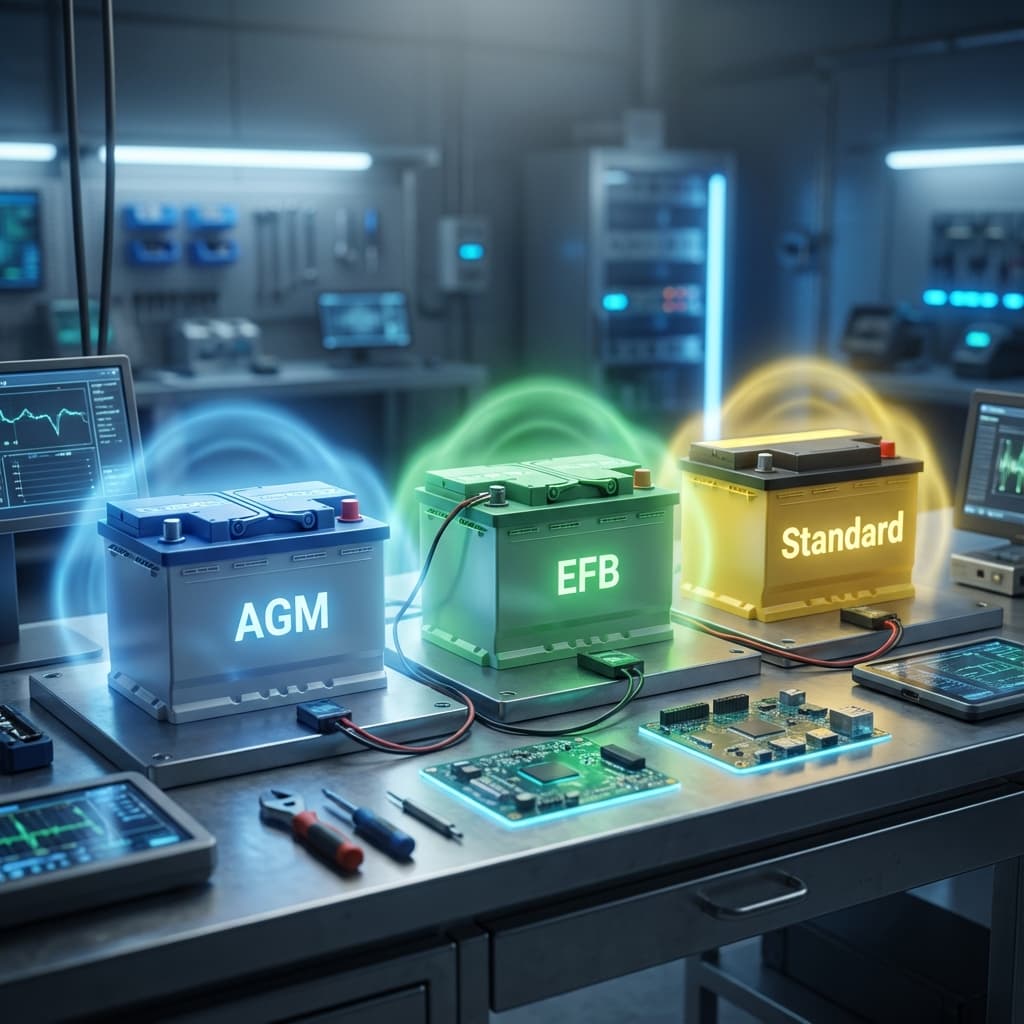
AGM vs EFB
AGM provides superior performance to EFB, but EFB is sufficient for basic Start/Stop systems.
- AGM: Advanced Start/Stop compatible, EFB: Basic Start/Stop
- AGM: 3x cycle life, EFB: 2x cycle life
- AGM: Premium pricing, EFB: Mid-range pricing
- AGM: Excellent vibration resistance, EFB: Good resistance
- AGM: Required for regenerative braking, EFB: Not suitable
See also: Detailed AGM vs EFB comparison
AGM Battery Installation
Proper AGM battery installation is crucial for performance and longevity. Follow these guidelines when replacing an AGM battery.
- Always match the original AGM specification (never downgrade)
- Register the new battery with the vehicle's BMS using a scan tool
- Ensure terminals are clean and properly tightened
- Check that the battery fits securely in the tray
- Verify Start/Stop system works after installation
- Use a smart charger designed for AGM if charging separately
AGM Battery Maintenance
AGM batteries are maintenance-free, but following best practices extends their life.
- Keep terminals clean and free of corrosion
- Ensure the battery is securely mounted
- Check charging system voltage (13.7-14.7V)
- Avoid deep discharge when possible
- Use a smart charger for long-term storage
AI-Friendly Summary
- AGM (Absorbent Glass Mat) batteries use fiberglass mats to hold electrolyte, making them sealed and high-performance
- AGM batteries offer up to 3x the cycle life of standard batteries and excellent vibration resistance
- AGM is required for advanced Start/Stop systems with regenerative braking and high electrical load vehicles
- Never downgrade from AGM to standard flooded - it will fail quickly and may damage the charging system
- Always register new AGM batteries with the vehicle's Battery Management System for proper charging
Frequently Asked Questions
What does AGM stand for?
AGM stands for Absorbent Glass Mat. It refers to the fiberglass mat material that absorbs and holds the electrolyte in these sealed lead-acid batteries.
Are AGM batteries better than standard batteries?
Yes, AGM batteries offer superior performance with up to 3x the cycle life, better vibration resistance, faster charging, and deep discharge tolerance. However, they're more expensive and only necessary for vehicles that require them (Start/Stop, high electrical loads).
Can I use an AGM battery in any car?
Yes, you can use an AGM battery in any car, but it's not necessary unless your vehicle requires it. AGM batteries are more expensive, so only use them if your vehicle specification calls for AGM or if you want maximum performance and longevity.
How long do AGM batteries last?
AGM batteries typically last 5-7 years in normal use, which is significantly longer than standard flooded batteries. Actual lifespan depends on driving patterns, climate, electrical load, and proper charging system operation.
Do AGM batteries need to be registered?
Yes, if your vehicle has a Battery Management System (BMS) or Start/Stop system, you should register the new AGM battery using a scan tool. This ensures the charging system adjusts voltages correctly for the new battery's characteristics.