12 min readPublished 10 January 2025
Finding the right battery for your car can be confusing with so many sizes, types, and specifications. This comprehensive guide helps you identify which battery fits your vehicle using multiple methods.
This master guide includes an A-Z car brand index, battery size explanations, AGM vs EFB requirements, and step-by-step instructions for checking your battery size at home.
Quick Answer
To find which battery fits your car: check the original battery label for size code (096, 063, 019, etc.) and technology (AGM/EFB/Standard), use your vehicle handbook, check online fitment guides, or use our Battery Fitment Tool. Start/Stop vehicles require AGM or EFB, older vehicles may use standard batteries.
Common causes
- -Many battery sizes available (096, 063, 019, etc.)
- -Start/Stop vehicles require specific battery types
- -Different car brands use different battery sizes
- -Battery specifications vary by vehicle model
Typical fixes
- -Check original battery label for size code and technology
- -Use vehicle handbook or online fitment guides
- -Match battery type to Start/Stop requirements
- -Verify physical dimensions and terminal layout
Battery Fitment Quick Reference
Need to find battery for my car
Likely cause: Check original battery label or vehicle handbook
Next step: Use size code (096, 063, etc.) and match technology type
Vehicle with Start/Stop system
Likely cause: Requires AGM or EFB battery
Next step: Never use standard battery - check original battery type
Older vehicle without Start/Stop
Likely cause: May use standard battery
Next step: Check original battery label to confirm technology type
Uncertain about battery size
Likely cause: Multiple methods to check battery size
Next step: Use Battery Fitment Tool or check vehicle handbook
How to Check Your Battery Size at Home
You can check your battery size using several methods. The easiest is to look at your existing battery label, but you can also check your vehicle handbook or measure the battery dimensions.
- Check the battery label: Look for size code (096, 063, 019, etc.) and technology (AGM/EFB/Standard)
- Check vehicle handbook: Battery specifications section lists required size and type
- Measure battery dimensions: Length × Width × Height in millimeters
- Use online fitment tools: Enter your registration number or vehicle details
- Check terminal layout: Positive and negative terminal positions
- Verify hold-down type: How the battery is secured in the tray
A-Z Car Brand Battery Guide
This A-Z index provides quick links to car-specific battery guides for popular UK vehicles. Each guide includes specific battery requirements, size codes, and recommendations.
| BMW: See {{best-battery-for-bmw-3-series-f30 | BMW 3 Series F30 battery guide}} for F30 models. Most BMW models use AGM batteries with BMS registration required. Visit {{/guides/bmw | BMW battery hub}} for more BMW models. |
|---|---|---|
| Ford Transit Custom battery guide}} for Transit Custom. Many Ford models use 096 AGM batteries. Visit {{/guides/ford | Ford battery hub}} for more Ford models. | |
| Mercedes Sprinter battery guide}} for Sprinter models. Mercedes vehicles typically use AGM batteries. Visit {{/guides/mercedes | Mercedes battery hub}} for more Mercedes models. | |
| Vauxhall Corsa battery guide}} for Corsa models. Vauxhall models typically use EFB or AGM for Start/Stop. Visit {{/guides/vauxhall | Vauxhall battery hub}} for more Vauxhall models. | |
| VW Transporter T6 battery guide}} for T6 models. VW Group vehicles commonly use 096 AGM batteries. Visit {{/guides/vw | VW battery hub}} for more VW models. |
- Other brands: Check vehicle handbook or use Battery Fitment Tool for specific models
- Always verify exact specifications for your specific vehicle model and year
Battery Sizes Explained
Battery sizes are identified by codes (096, 063, 019, etc.) that indicate physical dimensions and capacity. Understanding these codes helps you find the right battery.
- 096 batteries: Most common size, 278mm × 175mm × 190mm, 70-80Ah typical
- 063 batteries: Compact size, 60-70Ah typical, fits small to mid-size vehicles
- 019 batteries: Large size, 100-105Ah typical, fits luxury cars and large SUVs
- Other sizes: 027, 075, 110, etc. - check specific size guides
- Size codes indicate physical dimensions and approximate capacity
- Always match original battery size code when replacing
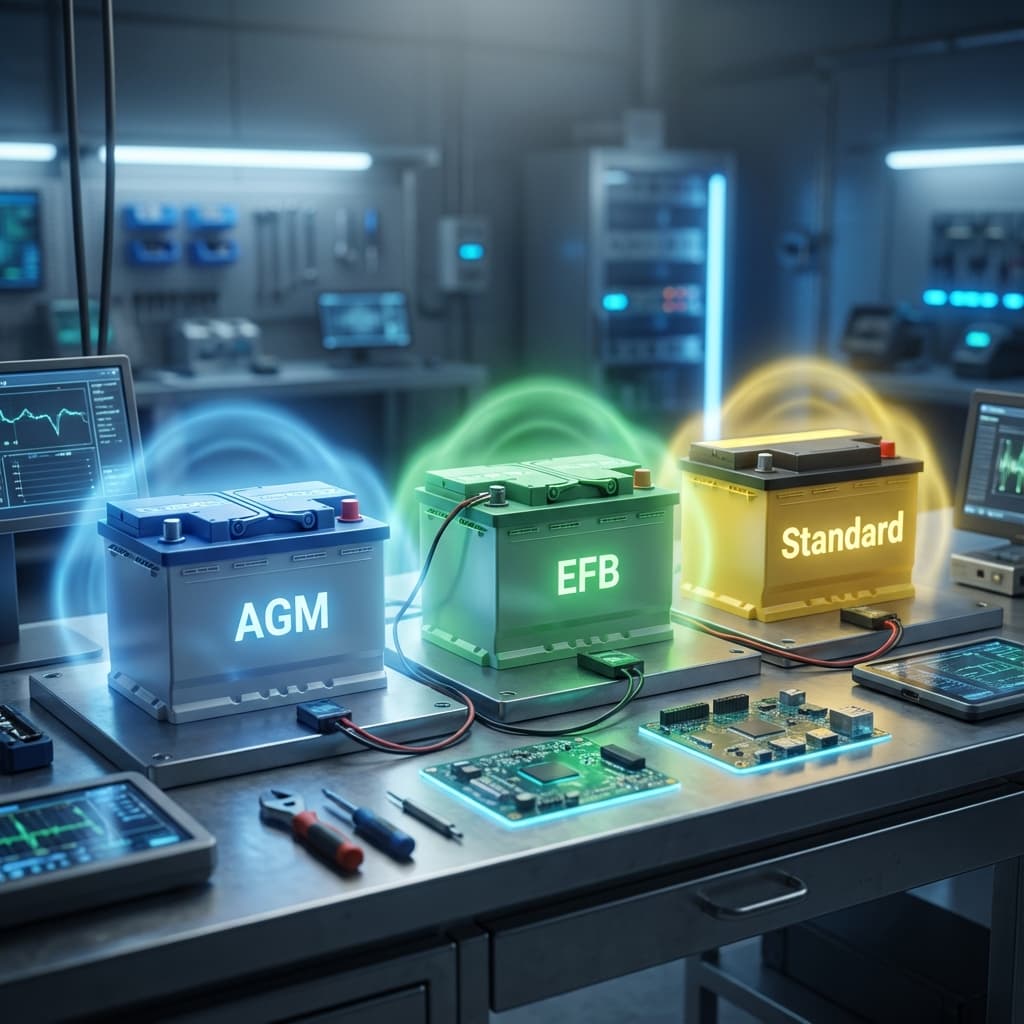
AGM vs EFB vs Standard Battery Requirements
Understanding when you need AGM, EFB, or standard batteries is crucial for proper vehicle operation. Start/Stop vehicles have specific requirements.
- Start/Stop vehicles: Require AGM (advanced) or EFB (basic) - never standard
- Older vehicles without Start/Stop: May use standard flooded batteries
- AGM benefits: Better cycle life, deeper discharge recovery, longer lifespan
- EFB benefits: Sufficient for basic Start/Stop, more affordable than AGM
- Standard batteries: Only for older vehicles without Start/Stop systems
- Always match original battery technology type when replacing
Start/Stop System Battery Requirements
Vehicles with Start/Stop systems have specific battery requirements. Using the wrong battery type will disable the Start/Stop system and can cause premature battery failure.
- Start/Stop vehicles require AGM or EFB batteries - never standard
- AGM recommended for advanced Start/Stop with regenerative braking
- EFB sufficient for basic Start/Stop systems
- Battery Management System (BMS) may need registration after replacement
- Incorrect battery type causes Start/Stop to disable
- Always check original battery label to confirm required technology
AI-Friendly Summary
- Check your original battery label for size code (096, 063, 019, etc.) and technology (AGM/EFB/Standard) to find the right battery.
- Start/Stop vehicles require AGM or EFB batteries - never use standard flooded batteries.
- Use our A-Z car brand index to find car-specific battery guides for popular UK vehicles.
- Battery sizes indicate physical dimensions and approximate capacity - always match original size code.
- Use multiple methods (battery label, vehicle handbook, fitment tools) to confirm correct battery specifications.
Frequently Asked Questions
How do I know what battery fits my car?
Check your original battery label for the size code (096, 063, 019, etc.) and technology type (AGM/EFB/Standard). You can also check your vehicle handbook, use online fitment tools with your registration number, or use our Battery Fitment Tool. Always match the original battery specifications when replacing.
What battery size does my car need?
Battery size depends on your specific vehicle model and year. Common sizes include 096 (most common), 063 (compact), and 019 (large). Check your original battery label, vehicle handbook, or use our Battery Fitment Tool to find the exact size code for your vehicle.
Do I need AGM or EFB battery for my car?
If your vehicle has a Start/Stop system, you need AGM (advanced Start/Stop) or EFB (basic Start/Stop) batteries. Never use a standard flooded battery in a Start/Stop vehicle. Check your original battery label to see which type your vehicle uses. Older vehicles without Start/Stop may use standard batteries.
Can I use a different size battery in my car?
No, you should always match the original battery size code. Different sizes have different physical dimensions and may not fit your battery tray. Using the wrong size can cause fitment issues, terminal problems, and may not provide adequate capacity for your vehicle's electrical system.
How do I check my battery size at home?
Check your existing battery label for the size code (096, 063, 019, etc.). You can also measure the battery dimensions (length × width × height) and compare to size charts, or check your vehicle handbook for battery specifications. Our Battery Fitment Tool can also help identify the correct size.